




By Sara Madaschi, SchoolScape, Centre for Educators
Dr. Maria Montessori wrote,
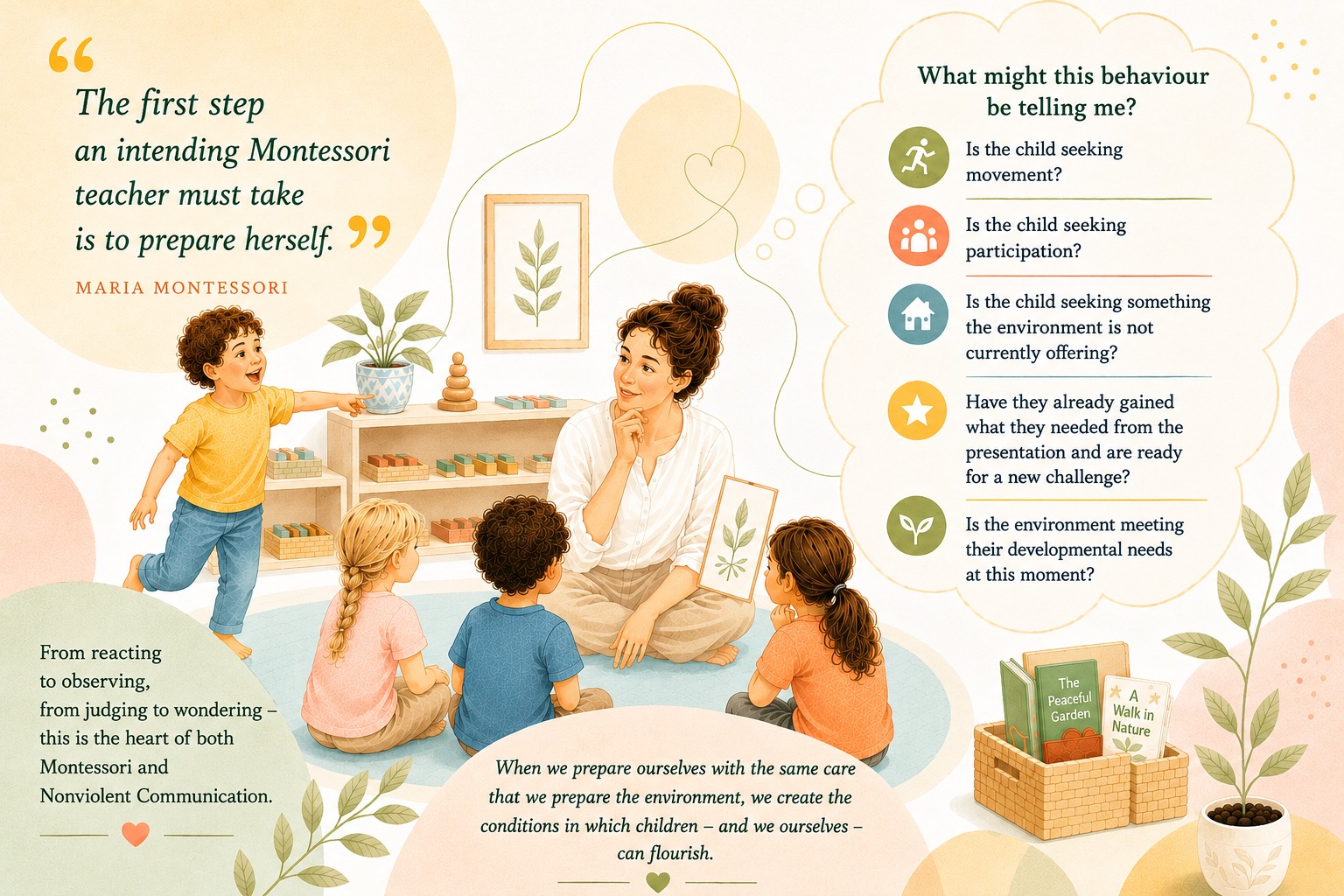
“The first step an intending Montessori teacher must take is to prepare herself.”
This preparation extends far beyond learning how to present materials or manage a classroom. It is an ongoing practice of cultivating observation, humility, patience, and trust in the child’s developmental process.
Observation is the ability to see the child with openness. It is also the practice of becoming aware of whatever within ourselves may shape our perception, so that we can recognise the child as they truly are rather than through the lens of our own expectations, assumptions, habits, or emotional reactions.
In this sense, the adult is an integral part of the prepared environment. The atmosphere of a Montessori classroom is shaped by both the physical environment and the adult’s presence, emotional balance, and the way they relate to the children, and the other members of the community.
This ongoing work of self-preparation is where Nonviolent Communication can offer valuable support.
Developed by Marshall Rosenberg, Nonviolent Communication (NVC) is an approach that cultivates self-awareness, compassion, empathy, and authentic connection by inviting us to look beyond thoughts, words, and actions to the feelings and needs that lie beneath them—in ourselves and in others.
Before it becomes a way of communicating with others, Nonviolent Communication is a practice of self-awareness and self-connection. As Marshall Rosenberg often said, “The most important use of Nonviolent Communication is to deepen our self-connection.” It invites us to notice our judgments, feelings, and needs before they shape the way we respond. This inner pause creates the possibility of choosing a response instead of reacting automatically.
Seen in this light, NVC becomes more than a communication model. It becomes a practical way of cultivating the prepared adult that Montessori envisioned, especially in those everyday moments that invite us to pause before responding.
Imagine a child who repeatedly interrupts a presentation. Our immediate reaction may be irritation or the desire to regain control. NVC invites us to pause and ask, “What is happening in me?” Perhaps I feel frustrated because I value order, or anxious because I want everyone in the group to remain engaged. Recognising these reactions is not about placing my own experience above the child’s. It is about acknowledging what is happening within me, so that I can respond with greater clarity and intention. By meeting my own experience with honesty and compassion, I create the inner space to respond rather than react.
From this place of awareness, I can turn towards the child with genuine curiosity. What might this behaviour be telling me? What might the child be feeling, and what needs might they be trying to meet? Perhaps they are feeling restless because they need movement, frustrated because they long to participate more actively, or disengaged because they are ready for a new challenge. Have they already received what they needed from the presentation? Is the environment meeting their developmental needs at this moment?
The answers are not always obvious, and they cannot be reduced to a simple formula. Yet this movement—from reacting to observing, from judging to wondering—fundamentally changes the relationship between adult and child. Instead of trying to correct behaviour, we begin to understand it as meaningful communication.
The goal is not to become a perfect educator who never feels frustrated or impatient. Montessori never asked for perfection. She asked for preparation. Nonviolent Communication offers a daily practice for that preparation, helping us return to ourselves so that we can more fully meet the child.
Ultimately, children do not need perfect adults. They need adults who are willing to observe themselves with honesty, meet themselves with compassion, and continue growing alongside them.
When we prepare ourselves with the same care that we prepare the environment, we create the conditions in which children—and we ourselves—can flourish.